


Interactive Orientation System
Transforming static corporate onboarding into a team-based gameplay experience
Timeline
May - Dec 2025
Team
3 designers
4 engineers
2 HR learning partners
My role
Design: 0->1 product design, learning experience design, 3D map modelling, QA throughout
Product & leadership: PRD creation & updates, stakeholder communication, timeline management
Results
Launched in Q4 2025, supporting 500+ users annually
Received company-wide recognition from CTO
background
Reimagining the onboarding activity

Innovation Lab
my org
A start-up–like, cross-functional team that partners across the company to prototype quickly and ship internal tools.
Request
Enterprise Learning Service
Needed an engaging way to convey company's history, mission, vision, and strategy to the new employees during the orientation.
The orientation was previously delivered fully virtually and was largely lecture-based. New hires struggled to stay engaged, and it was hard for facilitators to track participation.
With the opening of WSIB’s new headquarters, orientation day shifted to an in-person format, allowing us to design collaborative activities around the physical space and on-site equipment.
Solution
A team-based tour across the HQ, supported by a real-time system
User's loop
Team up
Form teams to connect with new hires across departments.

Explore
Navigate the new HQ and learn at each station.

Challenge
Work together on quizzes that reinforces key takeaways.

Reward
Celebrate progress with points and a leaderboard.

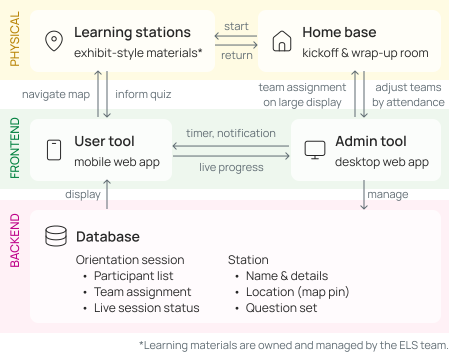
the three-layer system
process
From ambiguity to design decisions
At kickoff, the request was intentionally high level: design an educational experience for the in-person orientation.
A scavenger hunt quickly emerged as a natural direction, but that was just a start.
I found solutions from ambiguity by asking specific questions, which led us to move closer and closer to the final product.
Questions we asked the stakeholders
Click to see the decisions we made based on the feedbacks
How long is this activity?
Which areas of the building will be used?
What is your expected level of competitiveness?
How many participants?
How will you manage the content?
How many facilitators?
What might be the issue with users' devices?
Technical trade-offs
Live location tracking
Diverse question types
Learning material integration
outcome
Admin tool
Key features
Station management
Orientation session prep & participant management
Live session monitoring and control
01 prepare
02 monitor
User tool
Key features
Onboarding & team selection
Viewing 3D map & learning stations & paths
Checking-in at stations & completing quizzes
Viewing leaderboard
03 setup
04 play
reflection
What worked well
Take leadership
I challenged myself to take on PM responsibilities when forming the team. Because I designed the initial concept and worked closely with developers and stakeholders, I naturally became the go-to person for this project.
Leadership gave me the ability to help others, build trust with stakeholders, and steer the direction of the product.
Think in system
This project wasn't about a single function, but a system spanning physical space, online and offline interaction, two user groups (participants and facilitators), two frontends, and real-time events.
I had to think beyond one user flow, and used service design methods to map out this multi-layered system, which was messy but effective.
Design efficiently
I stuck to the company's existing design system, because it not only created brand familiarity for new employees, but also saved us time debating over minor design decisions.
While the DS provided basic components, I created product-specific patterns — such as the card component in the admin tool — when necessary, and kept them simple and versatile.
Practice prioritization
Early in the project, I ran a prioritization session with stakeholders and leadership, using an effort-vs-impact matrix to categorize features.
I maintained a tight feedback loop with developers — understanding the backend logic helped me balance user experience with development ROI.


